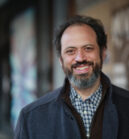

Guest appearances
Saul PerlmutterEvery podcast appearance, updated as new ones drop
physicist
- Episodes
- 6
- Shows
- 5
- Hours
- ~4
Tracked from 18 Oct 2022 to 6 Apr 2026
Recent guest appearances
Show 6 episodes — hide
- Ep148 "How can we improve political dialog?" with Saul Perlmutter
How can we improve political dialogue, and what does this have to do with the discovery that the universe behaves differently than expected? Why do we cling to beliefs even when evidence pushes against them? What if the biggest problem facing humanity could be solved with practice? Join Eagleman today with Saul Perlmutter, a Nobel-prize winning astrophysicist, but instead of the cosmos we talk about the inner cosmos: why polarization happens and how we might address it with a different kind of thinking.
- 445. How and When To Think Like a Scientist with Saul Perlmutter, John Campbell, and Robert MacCoun
In a world challenged by the politicization of data, contradicting evidence, and an onslaught of information, could the key to more effective and informed decision-making be as simple as, thinking like a scientist? Professor of physics Saul Perlmutter, professor of philosophy John Campbell, and professor of psychology and law Robert MacCoun combine their interdisciplinary minds in the book, Third Millennium Thinking: Creating Sense in a World of Nonsense. The book explores the essence of scientific thinking and how it can be applied to practical societal issues. Saul, John, and Robert join Greg to chat about the genesis of “third millenium thinking,” the role of values in scientific judgment, and the importance of teaching probabilistic thinking and experimentation. *unSILOed Podcast is produced by University FM.* Episode Quotes: Why is it so hard to just walk the Humean line and to be very explicit about sorting out these differences? 09:03: [John Campbell] The message of the book is: keep the Humean line as far as we can, separate the facts and values. Scientists, we all know, have a lot to tell us about the facts, but we, the people, are the ones who tell you about the values. And then, I think, that has to be anyone's first brush, sort of partitioning off the boundaries of science, to keep that Humean line. But then it does get complicated when you think about things like mental illnesses and so on, where you're asking not just, Is this condition that a person had? Is this a real thing? But you're also asking, Is this a bad thing? Is it a bad thing for a person to be like that? So with autism, is that just neurodiversity that is not really within the sphere of medical treatment at all? There are boundaries there as to where science is authoritative and where the people have a voice. And this kind of issue clearly has to be a debate, it seems to me. It's not something for professionals only. To what extent must we trust the processes within the expert community? 37:04: [Saul Perlmutter] I think that there's a difference between really understanding a field enough that you don't need the expert and having some understanding of how science works so you can recognize which experts you are more likely to trust. They myth of lone genius 47:26: [Robert MacCoun] This mythology of the lone genius, I think, is very much the antithesis of third-millennium thinking, this notion that it's because I'm brilliant that you should listen to me. And that's really not where we think the authority of science comes from. It's not from the IQ of the scientist. It's from the procedures—the hoops you have to jump through to make your ideas work. And it's those procedures that give you credibility, not just brilliance. If you hold to the Humean line, why would your value judgments about what's good or bad for society impact your causal arguments? 32:25: [Robert MacCoun] The role of standards of proof when you're dealing with probabilistic evidence, you need to weigh two kinds of errors: false positive errors of claiming a hypothesis is true when it's not, and false negative errors of saying the hypothesis is wrong when in fact it's true. That is not a scientific matter. That is a matter of values. We can't avoid it. In dealing with uncertainty, we have to impose some sort of standard of proof. And so, under the Humean model, you take values very seriously. I don't think we would argue that values are simply outside the domain of science. Show Links: Recommended Resources: David Hume Neil deGrasse Tyson Supreme Court over
- Ep. #233: Curiosity & Creating Sense in a World of Nonsense, with Saul Perlmutter
"We live in an experimenting society" Nobel Laureate Saul Perlmutter reassures us, "The fact that we can use partial information and do better is actually one of our superpowers." Third Millennium Thinking: Creating Sense in a World of Nonsense by Saul Perlmutter, John Campbell and Robert MacCoun takes the optimism and tools of science and helps us apply them to the everyday. They help us think about how we think, taking our values and fears into account, but not being overwhelmed by them. Third Millennium Thinking: https://thirdmillenniumthinking.com Photo by Jon Schainker. Used with permission. Theme music by Sean Balick; “Celestial Navigation" by Aeronaut, via Blue Dot Sessions.
- Life, the universe, and everything with Nobel laureate physicist Saul Perlmutter (Bonus)
Growing up, Saul Perlmutter just wanted to know how the world worked. In 2011, he was part of the Nobel Prize-winning team that discovered the accelerating expansion of the universe. Saul and Adam talk about how science and knowledge evolve, what surprising emotions come with discovery, and why the combination of individual humility and collective confidence can solve some of the world’s biggest problems. For the full text transcript, visit go.ted.com/RWAG6 ReThinking is produced by Cosmic Standard . Our Senior Producer is Jessica Glazer, our Engineer is Aja Simpson, our Technical Director is Jacob Winik, and our Executive Producer is Eliza Smith. For the full text transcript, visit ted.com/podcasts/rethinking-with-adam-grant-transcripts Hosted on Acast. See acast.com/privacy for more information.
- Life, the universe, and everything with Nobel laureate physicist Saul Perlmutter
Growing up, Saul Perlmutter just wanted to know how the world worked. In 2011, he was part of the Nobel Prize-winning team that discovered the accelerating expansion of the universe. Saul and Adam talk about how science and knowledge evolve, what surprising emotions come with discovery, and why the combination of individual humility and collective confidence can solve some of the world’s biggest problems. For the full text transcript, visit go.ted.com/RWAG6
- ReThinking: Life, the universe, and everything with Nobel laureate physicist Saul Perlmutter
Growing up, Saul Perlmutter just wanted to know how the world worked. In 2011, he was part of the Nobel Prize-winning team that discovered the accelerating expansion of the universe. Saul and Adam talk about how science and knowledge evolve, what surprising emotions come with discovery, and why the combination of individual humility and collective confidence can solve some of the world’s biggest problems. For the full text transcript, visit go.ted.com/RWAG6 For the full text transcript, visit https://www.ted.com/podcasts/worklife-transcripts Hosted on Acast. See acast.com/privacy for more information.
Stay in the loop
Get Saul Perlmutter's next appearance by email
No app to install. We email you as soon as a new guest spot drops.
Prefer it in your podcast app? Add a private feed →
GuestVine has tracked 6 guest episodes from Saul Perlmutter across 5 shows — about 4 hours of listening, going back to October 2022. Every episode links straight to the original publisher's audio.
Saul Perlmutter shows up most often on Worklife with Molly Graham (2 episodes), with visits to Inner Cosmos with David Eagleman and unSILOed with Greg LaBlanc. The conversations mostly sit in Science territory.
Most recent: “Ep148 "How can we improve political dialog?" with Saul Perlmutter” on Inner Cosmos with David Eagleman, 6 Apr 2026.
Podcasts Saul Perlmutter has appeared on
The shows with the most detected Saul Perlmutter guest appearances.
- Worklife with Molly GrahamLatest appearance: 18 Oct 20222 episodes
- Inner Cosmos with David EaglemanLatest appearance: 6 Apr 20261 episode
- unSILOed with Greg LaBlancLatest appearance: 26 Jul 20241 episode
- Choose to be CuriousLatest appearance: 30 May 20241 episode
- ReThinkingLatest appearance: 1 Apr 20241 episode
Appearance timeline
How often Saul Perlmutter has guested over time — by quarter, from tracked appearances.
Saul Perlmutter has appeared on 6 recent podcast episodes across 5 different shows. GuestVine keeps this list complete and up to date — new appearances are added automatically and delivered to the podcast player you already use.
Frequently asked
- What podcasts has Saul Perlmutter been on?
- Saul Perlmutter has appeared on 6 recent podcast episodes across 5 shows, including Worklife with Molly Graham, Inner Cosmos with David Eagleman, unSILOed with Greg LaBlanc.
- What is Saul Perlmutter's latest podcast appearance?
- The latest detected appearance is “Ep148 "How can we improve political dialog?" with Saul Perlmutter” on Inner Cosmos with David Eagleman, published 6 Apr 2026.
- How many hours of Saul Perlmutter podcast interviews are there?
- GuestVine has tracked about 4 hours of Saul Perlmutter guest appearances across 6 episodes, going back to 18 Oct 2022.
- How does GuestVine keep this list updated?
- GuestVine tracks delivered guest appearances, excludes own-show episodes where possible, and links back to the original publisher audio. New appearances are added automatically as they are detected.
Are you Saul? Add your live appearances to your site →
This page updates automatically every time Saul guests on a podcast. Link it from your site or bio so your audience always finds your latest appearances — and share it anywhere:
Paste this link into your site
<a href="https://guestvine.fm/p/saul-perlmutter">Saul Perlmutter — podcast appearances</a>